Sunday, 1 December 2013

Chalk Pastel Owls (with glue outline)


I'm still in love with chalk pastels.  They really can produce wonderful results for the children and I love seeing the smudged pastel on their faces afterwards.  Its always been a good art lesson when the kids are messy afterwards.


I've been wanting to use glue with chalk pastels all year as there are so many wonderful examples of this on Pinterest.  I'm pleased we finally got around to it.  It takes some planning though as the children need to draw and paint their outlines in glue one week and then colour in the picture the following week.  

What you need:
  • Black A3 paper
  • Glue in bottles (we used Elmers)
  • Pencils
  • Chalk Pastels
  • Fixative / Hairspray (optional)
  • Black Oil pastels (handy to have on hand for those children who were away the first week)
How to:

Week one:  Demonstrate how to draw a simple owl (I showed them wings in or out versions).  Draw this with pencil on the black paper then get the children to trace over this with the glue.  Younger children find controlling the glue whilst squeezing the bottle a little difficult.

Week Two:  Using chalk pastels colour in the picture covering all the black paper.  When finished spray with fixative or hairspray (optional).  Tip:  Use a wet cotton tip to clean the glue lines afterwards (you could get the children to do this themselves yet I did it for them mainly because I forgot to ask them to do it yet I also enjoyed doing it so I could admire their work..)

The Results:

Very cute.  These are produced by children in Prep and Grade 2!


NOTE: Notice the picture on the bottom left?  I had one bottle of clear Elmers glue out and this one used this.  The black glue lines show up much better!  However it isn't non run and it did run a little (maybe we didn't dry it completely flat?). The Elmers standard white glue did dry with a few bubbles too.

To finish the lesson (as I have very fast artists) we also worked on a second chalk pastel using a black oil pastel as the outline.  It was a free choice for my Tuesday group and the Thursday and Saturday groups worked to an insect theme.  I expected them to each do one big insect, yet the results show that you can never expect a certain result in art.  There were trees, leaves and multiple insects drawn.  Still all lovely and creative.


Our artist of the week was Pamela Pretty, a local pastel artist. Click here for her website.  Pamela's painting "Lofty " recently won the "Best in Show" award at the Pastel Society of Victoria annual exhibition.  Many of her paintings are of local places I've been and I love her style. She loves to paint "en plein air" where possible to capture the mood and colours of the places she visits. Her main media are oil and pastel and her subjects are usually landscape, seascape and dramatic skies.

Cheers
Fiona


Thursday, 21 November 2013

Aboriginal Painting and Making our own Paints


My children are often found crushing up rocks and making them into paints so I thought this would be a fun idea to incorporate into an art lesson.  Making your own paints is very messy yet lots of fun.  I've also been wanting to do an Aboriginal themed lesson and have been storing bark pieces for nearly a year in anticipation.  Naturally these ideas go extremely well together as many of the early Aboriginal paintings were done with natural materials such as clay, berries, charcoal, chalk, and coloured rock.


I'm lucky to live near some lovely red / yellow / orange cliffs called "Red Bluff".  I went for a walk along the beach one morning and gathered up some pieces of rock lying around on the sand (along with some pebbles for painting on).  I also gathered some natural materials to paint with - banksia flowers, leaves, sticks, grasses, pine cones and seeds.

Part One - Making our own paints

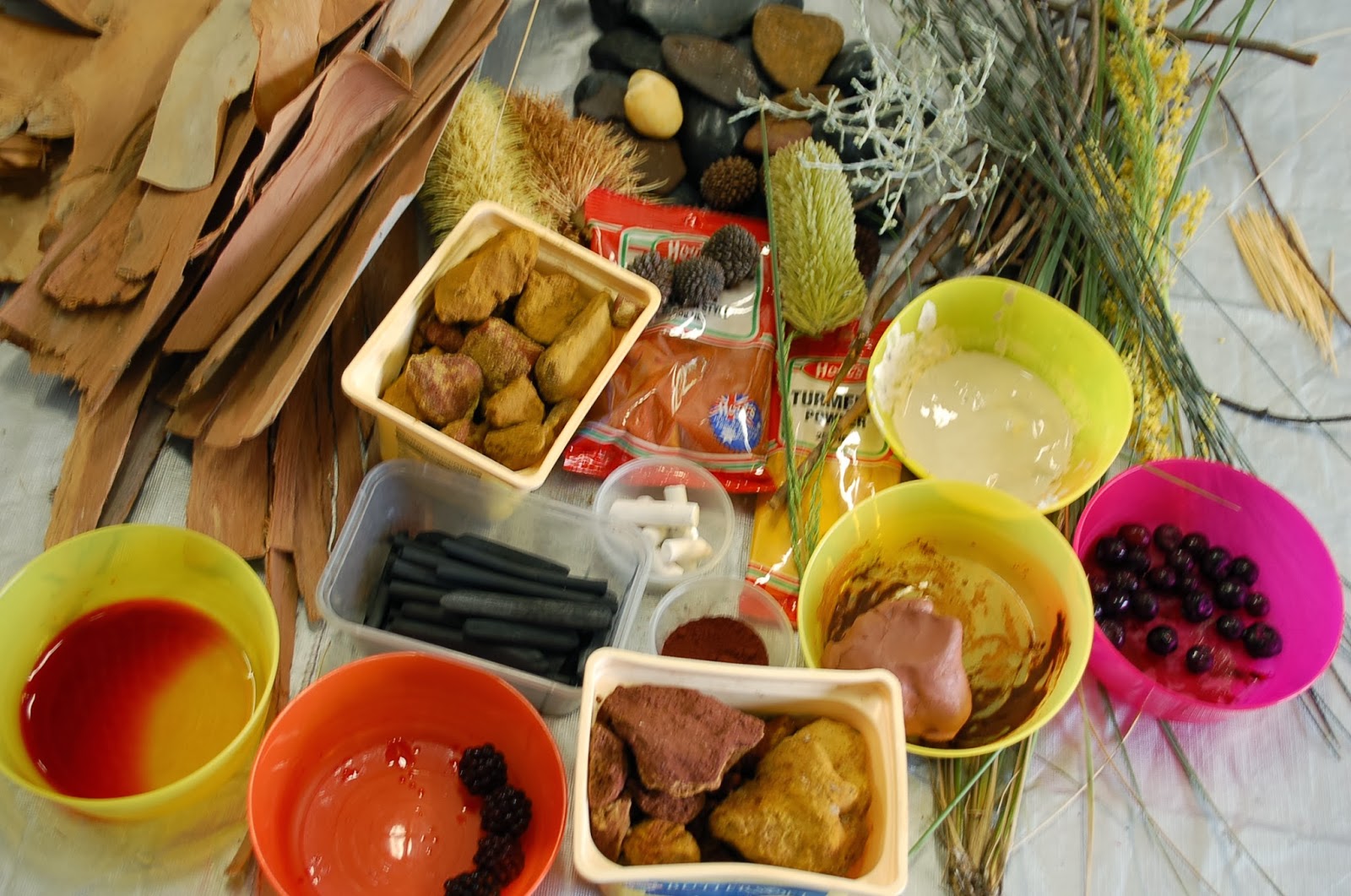
We discussed as a class what materials natural paints could be made from then progressed into making our own from the materials on the table.  I supplied the following:
Charcoal - Black
Red rock, paprika, red clay, iron oxide - Red
Turmeric, yellow rock - Yellow
White clay, chalk - White
Blue Berries, Black Berries, Beetroot juice - Purple / Pink

The children used a mortar and pestle to crush the rocks into a fine powder.
I supplied lots of plastic bowls, spoons and jars of water to mix the paints in.
For a "binder" to make the paints stick to the paper we used glue, cornflour and water paste or egg mixed in with the paints.  Traditionally tree sap was often used.

This was all rather messy with lots of washing up to be done afterwards yet was lots of fun
Supplies for making our own paint
Part Two - Painting with our Paints

The children were then handed white or black paper (their choice) to draw an Aboriginal design on.  We discussed how symbols were often used (I handed out a page with some example symbols on it) and how Aboriginal paintings often tell a story.  We also discussed Native animals children could draw and I had some templates on hand if they wanted to draw around these.  Dot painting was also discussed.  I pretty much left it to them to do the paintings how they liked.  Although I encouraged them to take their time and give a dot painting a try many just added a few dots or did a more abstract painting.  I had visions of beautiful slowly done dot paintings yet with children aged 5-9 years this was probably a bit over ambitious.


We had no paint brushes on the table so they could paint with the natural materials (although I also supplied some cotton tips).  The natural paints are not the easiest to paint with so I had some normal paint in natural colours on hand if anyone got a little frustrated.

We also painted on the bark and pebbles.  Some children painted the animal templates.

Painting on bark

Painting on rocks / pebbles

Painting animal templates

Part Three - Hand Prints

As a final step we discussed how hand prints are often found painted on rocks and in caves.  This is done by blowing white paint / chalk through a long wooden tube.  We did our own version of this by spraying watered down white paint over hands placed on some brown packing paper.


Our artist of the week was Aboriginal Artist Michael Jagamarra Nelson.  Click here for his biography. 

Cheers
Fiona


Wednesday, 20 November 2013

More Seahorses

A few weeks ago Tuesday was Cup Day in Melbourne so with only two classes to teach I decided to mix things up a bit.

The Thursday class missed out in doing Seahorses last term when they had a public holiday and I've had a few requests.  Click here to see my previous post and instructions.

Here are the results:
I love how these are so bright and colourful.  We forgot to add glitter to some of these yet they are beautiful anyway..

Watercolour Seahorses by 6-9 year olds
I decided to teach the Saturday class some colour theory since they are all new to my classes and we hadn't done any yet.  I repeated the lesson on "Colour Theory, Paul Klee and Painting on old book pages".  Click here for that post.

Cheers
Fiona

Tuesday, 5 November 2013

Witches Legs


I've seen a few versions of these on Pinterest.  So cute! I applied the same technique we used for our Happy Penguins. A tempura cake painted background (minimal clean up and dries fast), coloured paper and lots of embellishments.

What you need:
  • A3 white paper
  • coloured & black paper
  • Precut boots (I decided to do this as I could see the children struggling with this)
  • sequins
  • black lace
  • buttons, bells etc
  • glue
  • oil pastels
  • sissors
  • black wool and pom poms
  • tempura paint & brushes


How to:
  • Ask each child to paint a background using tempura cakes
  • Leave to dry (we did the spooky trees during this time)
  • Arrange legs, boots and piece of paper for skirt on the paper
  • cut out skirt
  • glue everything down
  • add embelishments
  • use oil pastel to add details
  • add spider and thread (optional)

The Results:
Done by 5-9 year olds.  V cute. I love the ones with the boots pointing inwards. Great work!

Cheers
Fiona

Thursday, 24 October 2013

Klimt's Tree of Life

I read somewhere that Klimt's "The Tree of Life" painting is one of the most reproduced oil paintings, so I thought we should do it too!  Its also the appeal of painting in GOLD paint - so luxurious.....


There are quite a few lesson plans out there for this. I really wanted to paint in thick gold paint on black paper so I've based our lesson on the version posted on We Heart Art.

What you need:
  • Gold Paint (we used a very thick acrylic paint called Dimension paint.  This enabled the children to add the paint very thick in the style of Klimt)
  • Black A3 paper
  • Sequins
  • Glue
  • Metallic blue, purple, silver and white paint (optional)
How to:
  • Discuss Klimt his work, his style and the "The Tree of Life" painting
  • Pass out some handouts with simple steps on how to draw the tree
  • Ask the children to try and fill their page with the spirals
  • Add details with the other paints
  • Add sequins (we did this after the paint had dried)
The Results:

Love all that gold and colour from the sequins...

The Tree of Life by 5 to 9 year olds.

Our artist of the week was Gustav Klimt of course!

The Tree of Life by Gustav Klimt, 1905


Cheers
Fiona

Tuesday, 22 October 2013

Expanding Scary Fish

This lesson produced so many giggles and "fake" screams - it was lots of fun.  The children just loved the concept of the hidden scary fish.  They opened and closed them millions of times.  This lesson was done by children 5 to 9 years.  It takes about 40 minutes.


I can't take credit for the idea I saw this on the website "Once Upon An Art Room". 

What you need:
  • A3 white paper, folded (I just played around until I worked out how to get the folds about right.  I then prefolded the paper before the lesson as I imagined the children finding this difficult).
  • Oil Pastels
  • Blue Liquid Watercolour paint (optional - add glitter)
  • Large Paintbrushes
  • HB Pencils & Eraser
How To:
  • Demonstrate how to draw a fish using the fold as the centre (I demonstrated an easy fish with an oval and triangle for a tail). 
  • Ask the children to draw their fish with a pencil (I found using a pencil helpful as many found the concept of drawing the fish with the fold in the centre hard and we could rub out the pencil until we got it right, don't worry too much about pencil lines as the oil pastel covers them)
  • Add an eye ensuring it is above the fold
  • Expand the paper and fill in the blank space with a big mouth and teeth.  Fill in the tail.
  • Colour fish using oil pastels ensuring they are applied very thick and covering all the white
  • Outline in black oil pastel
  • Add in bubbles with white oil pastel (optional)
  • Paint over entire piece of paper with blue watercolour (we also used paper towels to dab away some to show ripples in the water)
  • Allow to dry and then refold.
The Results:
 Some very scary fish.....-


Cheers
Fiona

Saturday, 19 October 2013

More Georgia O'Keeffe Watercolour Flowers


This would have to be my favourite lesson.  It always produces wonderful results and is a great introduction to watercolours. Children as young as 5 can produce amazing flowers and even the boys seem happy to do a flower (I tell them it can be for mum).  Click here for my previous post and directions.

I ran a holiday workshop on this subject and my new Saturday class (2 places still available click here for details) just did this lesson so I couldn't resist posting some more photos.

So lovely and colourful........


Cheers
Fiona